


|
Quantity
|
Total
|
||
|
|
|||
|
|
|||
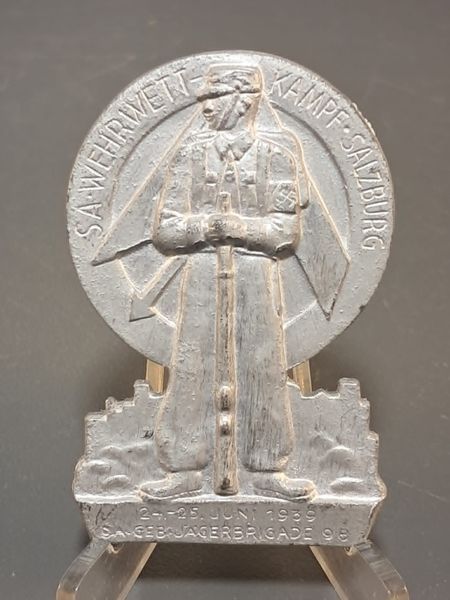
An authentic German commemorative tinnie badge preserved in excellent, complete condition, officially issued for the SA military defense sports competition held in Salzburg on June 24–25, 1939. The obverse features a highly detailed high relief of an alpine mountain trooper wearing a traditional field cap while standing on guard and holding his rifle vertically. The trooper's figure is artfully integrated into a geometric background representing a mountain peak or tent with a sharp arrow, while the lower border is shaped like a fortress wall bearing the clearly embossed dates and the organizational unit name SA-GEB.JÄGERBRIGADE 98. The reverse displays a flat, uniform cast finish typical of the era, showcasing an embossed RZM control symbol inside a circle on the left side and the precise numerical manufacturer code M9/169 on the right. The item is manufactured as a solid lightweight aluminum casting, equipped with a classic vertical safety pin mounted on a sturdy base plate which remains fully secure and functional. The entire metal surface exhibits a genuine light grey aluminum patina along with natural aging inside the recesses, beautifully highlighting the lettering and features without any modern alterations.
Country of origin: Germany / Austria (Salzburg)
Manufacturer (markings): M9/169 (Deschler & Sohn, Munich)
Organization and unit: Sturmabteilung (SA), SA-Gebirgsjägerbrigade 98
Event and date: SA-Wehrwettkampf (Defense Sports Competition), June 24–25, 1939
Material and technique: Aluminum, lightweight die-cast construction
Attachment type: Classic, complete vertical safety pin factory-mounted to the base
Condition: Very good, high detail preservation, crisp text and legible RZM marks
Historical context:
The Wehrwettkampf paramilitary sports events were organized to enhance military readiness, foster competitive spirit, and provide tactical training for SA members just before the outbreak of World War II. This specific badge is directly tied to the 98th SA Alpine Brigade operating in Austrian territory shortly after the Anschluss, with its manufacturing outsourced to the elite Munich firm Deschler & Sohn under the strict quality regulations of the Reichszeugmeisterei, making this aluminum variant a scarce and highly collectible historical artifact.