








|
Quantity
|
Total
|
||
|
|
|||
|
|
|||
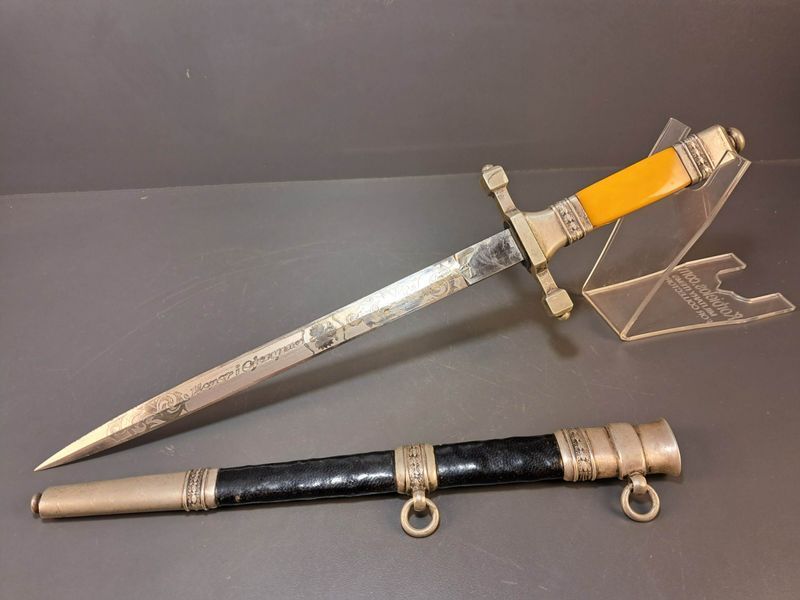
The presented dirk (dagger) is an authentic, historical item from the period of the Second Polish Republic (II RP). This is the Pattern 1924 model or the later standardized Pattern 1937 version, produced by the well-known Warsaw manufacturer G. Borowski. It was part of the equipment for officers of the Polish Army during the interwar period and the early stages of World War II.
Appearance and Condition
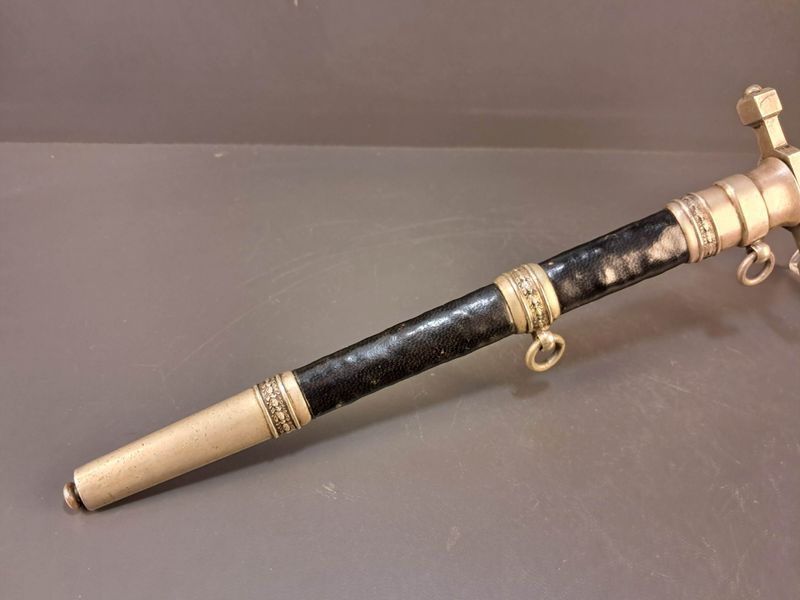
- Material: The metal fittings (cross-guard, pommel, scabbard mounts) are made of metal, probably brass or tombac, with preserved gilding or nickel plating. The grip is made of a plastic material in an ivory/yellow color. The scabbard is covered in black, ribbed leather.
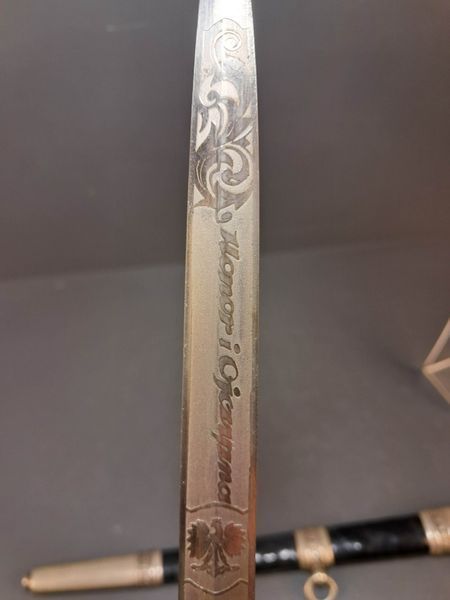
- Condition: The item is in very nice, original condition. A light patina is visible on the metal fittings, and the leather on the scabbard is well preserved. The details of the etching on the blade are sharp and clear. This is a nice, collectible example.
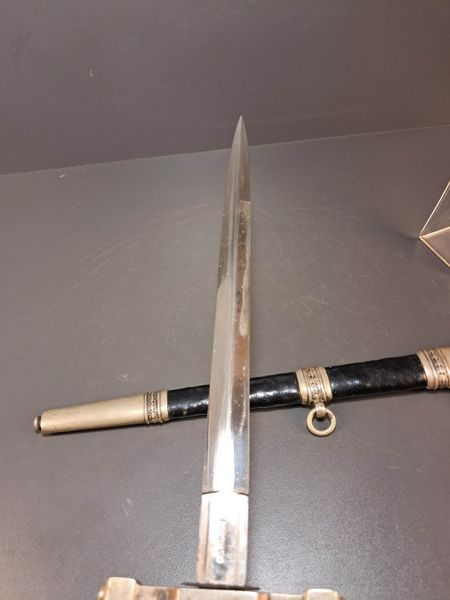
- Blade: The dirk's blade is nickel-plated (or chromed), with a cross-section in the shape of a rhombus. The outer flat of the blade features etching with the national emblem (the White Eagle) and the motto "Honor i Ojczyzna" ("Honor and Fatherland").
- Grip and Cross-guard: The cross-guard is straight, with spherical ends. The pommel is decorative, and the grip is four-sided with rounded edges. Metal rings with ornaments are visible.
- Scabbard: The scabbard has upper and lower fittings made of brass/tombac and two carrying rings (suspension loops).
- Markings: No visible manufacturer's markings on the visible elements, although on the blade, in a location not visible in the photo, there was often a signature of the G. Borowski factory from Warsaw.
Historical Context
The officer's dirk wz. 1924 (later wz. 1937) was the personal sidearm of Polish Army officers in the interwar period. It was introduced to replace sabers as a less formal part of the service uniform. It was used by officers of all branches of the armed forces, including the air force and armored forces. These dirks, produced by G. Borowski among others, were worn both during peacetime and during the September Campaign of 1939.